


The first decade of the twentieth century was a pivotal era for two-wheeled transport in Britain. Motorcycles evolved from simple motorised bicycles into purpose-built machines, and by 1910 they had begun to capture the public imagination, for utility, speed, and style. Below is a compact history of how they rose to fashion, who the leading makers were, and which brands and styles were the most desirable on British roads around 1900–1910.
From motorised bicycle to desirable machine
At the turn of the century, the idea of putting a small petrol engine on a bicycle frame was a novelty that solved a clear problem: faster, cheaper travel than a horse and far more flexible than the early, expensive motor-car. Early showrooms (for example, the Stanley Cycle Show in London) displayed machines that looked like bicycles with engines attached; within a few years, manufacturers were designing frames, engines and fittings specifically for motorcycling rather than adapting bicycle parts. Royal Enfield, for example, produced its first motorcycle in 1901, showing how cycle firms rapidly pivoted to the motor trade.

A major driver of popularity was practicality. For many rural and suburban riders, a motorcycle was an affordable way to commute, deliver goods, or cover longer distances for leisure. As reliability improved and dedicated motorcycle parts (clutches, ignition systems, stronger frames) were developed, bikes became less temperamental and more attractive to middle-class buyers. Museums and historians emphasise that motorcycles quickly moved from engineering curiosities to genuine transport, and then, within a few years, to sporting objects and icons of personal style.
Racing, the TT and the celebrity effect

One of the fastest routes from a useful tool to cultural object was racing. The Isle of Man TT, inaugurated in 1907, gave manufacturers a public stage to prove speed and durability. Norton-engined machines and other emerging marques used competition success as advertising: a win on the TT or strong showing at local trials could turn a workshop into a household name overnight. Rem Fowler’s and other early riders’ exploits established the myth that motorcycling was both modern and heroic, helping make bikes fashionable among young men and sporting types.
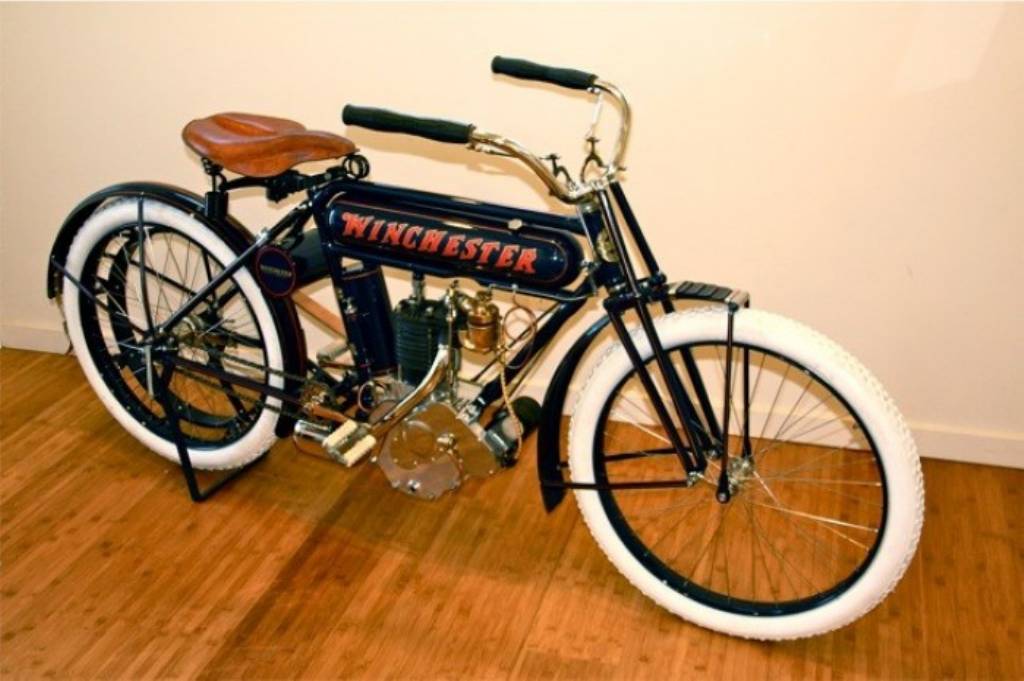
A USA made 1910 Winchester model sold for $580,000 in 2013, setting a record at the time and cementing its legendary status. Commissioned by Winchester, it used top-drawer, patented parts and materials, making it a luxury item for its time. These were expensive, high-end machines built with top-patented parts, intended for the wealthy, much like the luxury cars of the era.
Owning a motorcycle in 1905–1910 carried social signals. It suggested independence, technical modernity and a taste for speed. Advertisements of the period tended to show smartly dressed riders, and makers marketed machines as both practical transport and as objects of aspiration. The motorcycle’s image as a modern gadget, faster than a bicycle, cheaper than a car, helped it slot into Edwardian Britain as a visible sign of personal mobility and style.
By 1910, motorcycles had gone from tinkering experiments into an acknowledged part of British life: tools for work, machines for sport, and symbols of modern living. If you were buying in that decade and wanted the most fashionable, sensible choice, a Triumph or Royal Enfield single-cylinder model offered the best blend of reliability and social cachet, while Norton or Scott carried the bragging rights of the racetrack.


